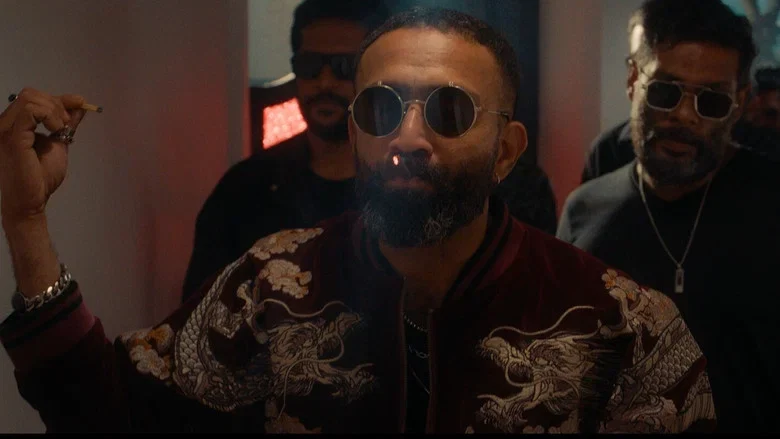
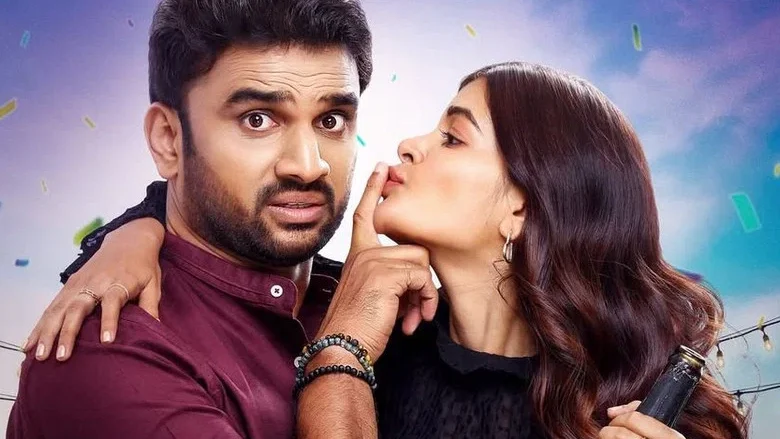
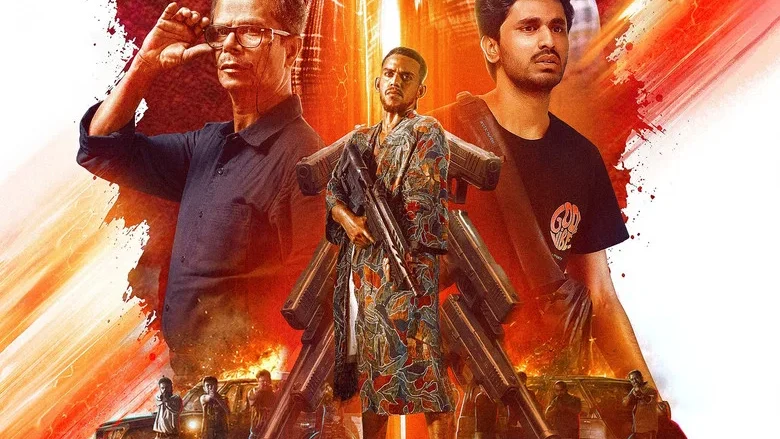
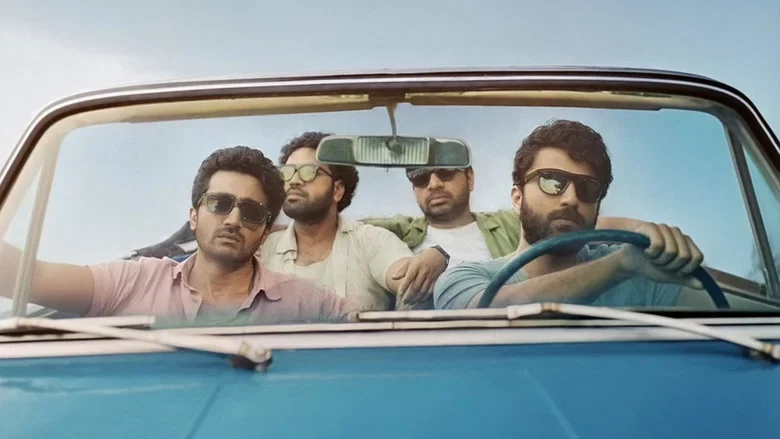
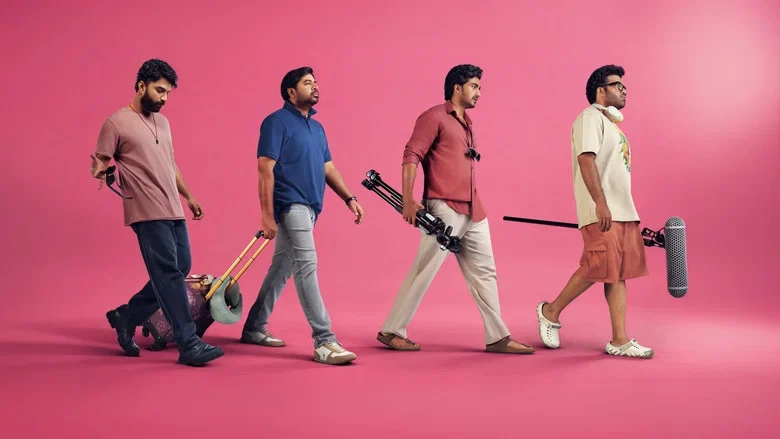
The four of them are back in the same frame, older, softer around the jaw, and already lying to each other about how well life has gone. The reunion is the whole pitch, and the film knows it.
A Sequel That Opens With Nostalgia Instead Of A Problem
Tharun Bhascker Dhaassyam returns to the world of Ee Nagaraniki Emaindhi eight years on, and the opening movement is built almost entirely on re-acquaintance. Vivek, Kaushik, Uppu and Karthik are restored to us with their old rhythms intact, their old arguments still warm.
What the first half hour refuses to supply is a crisis. The trigger is a spontaneous plan, a vague itch about unfinished business, and a group of men who cannot say a hard sentence to each other without wrapping it in a joke.
That is a legitimate comic engine. It is also a structural gamble, because a reunion scene can carry charm for exactly as long as the charm lasts, and no longer.
When The Engine Is Friendship, Someone Has To Stop The Car
The middle stretch runs on escalation, and the escalation is entirely self-inflicted. Casual decisions curdle into unexpected situations, and the film asks us to enjoy watching four grown men discover that consequences are a thing that happens to other people.
Bhascker has always been good at that specific panic, the male group brain that makes a decision collectively and then blames nobody. The ensemble swagger of a certain kind of Telugu comedy lives or dies on this, and here the swagger is intact even when the plot is not.
Where the film gets thin is the absence of a counterweight. There is no antagonist, no external clock, no opposition with a face. Interpersonal friction is asked to do the work that a plot usually does, and friction alone tends to settle into a rhythm.
Vishwak Sen Plays The Anchor, And The Anchor Is The Least Interesting Man In The Room
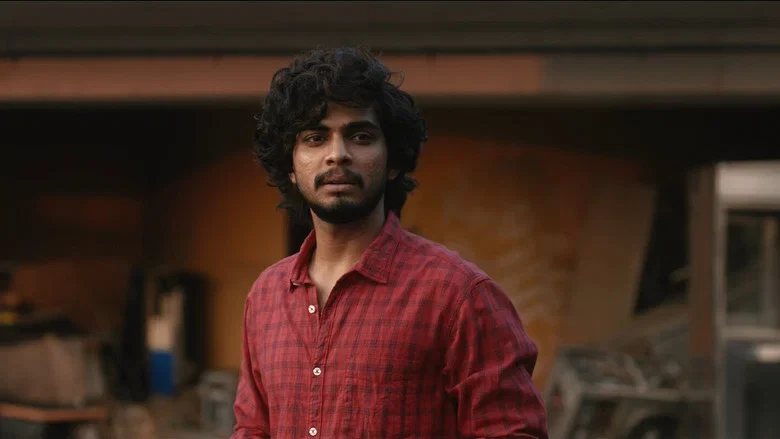
Vishwak Sen’s Vivek is the returning centre, the one through whom the reunion is organised, and he plays the role with a deliberate flatness. Watch his shoulders in the group scenes: he is the one who arrives last, sits slightly outside the circle, and lets the other three fill the air before he commits.
It is a restrained choice, and a slightly thankless one. The comic voltage is elsewhere, in Abhinav Gomatam’s Kaushik, who does a small piece of business with his hands every time he is about to lie, and in Venkatesh Kakumanu’s Uppu, whose timing is all in the pause before the punchline rather than the punchline itself.
Sen’s better register has always been the wounded one, the man who has been quietly let down and is deciding whether to say so. There are traces of it here, and they flare in the moments when Vivek’s adult life intrudes on the group’s adolescent momentum.
That register is exactly what carried the more melancholic passages of his fractured romance work, and the contrast is instructive. In that film the sadness had a shape. Here it is a mood that drifts in and out of a comedy that is not always sure it wants it.
The Camera Keeps Its Distance, And The Distance Costs Something
Bhascker’s visual grammar remains unfussy and observational, favouring medium-wide framings that let four bodies occupy the same space without cutting between them. It is a disciplined approach, and it pays off in the conversational scenes where the comedy is spatial rather than verbal.
It also means the film has no visual answer for its emotional peaks. When the group finally has to say something true to each other, the camera stays where it has been all along, and the moment has to be carried entirely by the performers.
They mostly can. The best of these scenes is a two-hander late in the second act where the group has briefly fractured and two of the friends sit in a car that is not moving, and the comedy drains out of the frame in real time.
The screenplay’s insistence on resolving tension through warmth rather than confrontation is a recognisable house style, and it is the same instinct that made the more uneven stretches of a certain contemporary Telugu comedy feel like it was apologising for its own darker instincts.
The Studio Bet Is On Continuity, Not Novelty
The commercial logic here is straightforward and slightly conservative. This is a sequel banking on a 2018 film’s residual affection, with advance bookings reported at ₹1.62 crore across the first four days and Telangana leading Day 1 sales, which tells you the audience is nostalgic rather than curious.
That is a real bet on franchise continuity in a market where the contemporary Telugu comedy space is crowded with original voices and much louder concepts. The producers are wagering that four familiar friends are safer than one unfamiliar idea.
Sen’s box-office leverage is the other variable. He has spent the last several years building a following on intensity and physical presence, and this film asks him to be the quiet one in a loud ensemble, which is not where his commercial value has been concentrated.
The Ending Resolves The Friendship And Leaves The Men Exactly Where They Were
The closing movement returns the group to each other, and the film treats that return as sufficient. Nobody has grown in any measurable way. The unfinished business gets talked about rather than resolved, and the last scene is warm in a way that is careful not to ask what happens on Monday.
That is a choice, and it is a coherent one for a buddy comedy that believes friendship is the point rather than the problem. But it leaves the sequel in an odd position: it has extended a story without deepening it.
Bhascker remains one of the sharper observers of how men talk to each other when they are avoiding the actual subject, and there are twenty minutes here that are as good as anything in his filmography.
The rest is a reunion that is happy to see us and has not quite worked out what to say next.